

The house is dying. No getting around it. Houses routinely live for hundreds of years, so when one does die, especially before its time, it’s a real tragedy. It’s not something you can plan for, either. No inspector in the world can tell you how long a house has left to live. One day, it’ll just happen. You can get upset about it, wonder why it’s happening to you and not someone else, but there’s not a thing you can do to stop it.
I noticed the first sign of it in the bathroom. A spot, greenish-black and bulbous like a mole, just above the showerarm. It looked like mold to me. I doused it in bleach and wiped at it with an old rag. When it was still there after the third pass, I called a professional.
The professional lumbered out of his van and into my bathroom, carrying his little folding step ladder and tool bag. He was sealed in a blue coverall uniform with an embroidered name patch on the left breast pocket that read CHUCK.
He stared at the spot from an inch away.
“That ain’t mold,” he said.
“What is it, then?”
“Rot.”
“What do you mean rot?”
“Decomposition. Decay. From dying.”
Chuck unzipped his tool bag, fished around inside, and handed me a slim pamphlet.
A Homeowner’s Guide to Death: Funerary Rites and Responsibilities
“You wanna follow that so you don’t have any trouble with the insurance company.”
He gave me a swift pat on the back. My blood boiled. Chuck the mold guy with his pressed uniform and galvanized steel tools with rubberized handles and compact little bag with a mesh compartment just the right size for a pamphlet, as if he’s announcing to the world, look at how fucking prepared I am, I can crawl into any rotting old dying house, devastate the rube who lives there, and then hop back in my stupid van and go home like it’s no big deal.
I wanted to hit him.
When he was gone, I threw the pamphlet into the kitchen drawer where I keep the takeout menus and old batteries and slammed it shut.
Chuck. I thought that there must be someone who could tell me everything was fine and that Chuck didn’t know what he was talking about. I dumped bleach onto the spot and wiped it again.
I cooked dinner and tried to take my mind off it. A dry-aged steak from the butcher, garlic butter cremini mushrooms, Pommes Anna, roasted broccoli rabe, arugula salad. I hadn’t cooked like that in a while.
The last time I had was after my wife had come home from work in a foul mood and did what she normally did when she felt that way, which was to ask how my job search was going. I hadn’t applied to anything lately. The rejection was putting a damper on my motivation.
When being purposefully dishonest, it’s best to obscure the big lie, the real thing you don’t want discovered, with a more innocuous one. A smokescreen. A softball that’s easy to sniff out so that the party being lied to can believe they’ve uncovered the bullshit they’re no doubt detecting. The other thing is believing the lie yourself. The first person you’ve got to fool is you, because if you believe it, you’re not so much lying as mistaken, and mistakes happen all the time. So that’s what you should strive to be. Mistaken. If you’re going to lie, that is.
The problem is that I’m no good at lying on the spot. I need time to prepare.
What I ended up saying was that I had a couple promising leads that were maybe a bit above my experience level. She reminded me that I’d been unemployed for a year. She asked why I was applying to jobs above my experience level. I fumbled for an excuse. She asked why I was lying. I fired back by asking her what the big rush was, since we were doing okay for now, we had savings, and it wasn’t like we had kids to support.
Sticking my finger in that wound just to score a point wasn’t the best strategy, I know.
She said something about how I might still have a job if I weren’t such an asshole all the time, which was fair. But I made her a nice dinner, and things were alright for a while after that.
Now, alone, I tried not to think of those words Chuck had used.
Rot.
Decay.
I couldn’t help myself. I even started to smell it, the stench of death. I ate and tried not to breathe, but the putrid smell I couldn’t possibly be smelling wafted over the back of my tongue and up into my nose.
A few days later, the bathroom looked smaller.
I woke to an email from my wife and her lawyer, reminding me that I had agreed to find a listing agent for the house. Being out of work meant the admin of our divorce proceedings fell to me.
I had been graciously allowed to live in my own house until the settlement was finalized and I could afford to move. She was staying with a friend. She’d be back from a conference later in the day, expecting an update.
I got started with my morning routine, which included jerking off, taking a shower, then shaving before breakfast. Something caught my attention as I was warming up. The ceiling above the toilet looked wrong. I stepped back through the doorway and studied the corner. It was subtle, but everything seemed to be shifting inward. Sagging.
Again, I thought of Chuck.
I didn’t feel like jerking off anymore. I turned on the shower, and while I waited for the water to heat up, I thought I smelled something, maybe a whiff of sewer backflow, but it was so faint, I couldn’t tell if it was really there.
Stepping into the shower was like falling face first into a pile of week-old meatpacking waste. I jumped out and killed the water. The smell dissipated. I smelled the skin of my arm. Nothing. In the tub were soft footprints where I’d stood. I leaned over the side, put my face right up to the prints, and then it hit me. Decay. Decomposition. Spoilage.
The chemical compounds responsible for the odor of decay are called putrescine and cadaverine. No joke. They’re also found in semen. They protect your precious DNA from the acidity of the vaginal canal.
Chuck was right. The house I loved, the house where I thought I’d spend the rest of my life, was dying. We didn’t need a realtor. We needed an insurance payout. Without one, I’d be so far underwater, I may as well just stay put until the roof caved in.
I dug the pamphlet out of the kitchen drawer and spread it across the island.
A Homeowner’s Guide to Death
As the steward of a House, no responsibility is of greater importance than ensuring a proper Death. Performing funerary rites is not only an ethical duty, but a practical one. Improperly deceased Houses have been known to cause acute, localized barrenness, preventing vegetative growth and ensuring Death-On-Arrival of any henceforth erected structure. Homeowners are therefore required by insurance providers to perform funerary rites and demonstrate land viability before any claims can be paid.
The funerary process spans three days. The rites contained herein must be carried out on successive days.
Day One: The Viewing
A Homeowner initiates the rites by viewing the living embodiment of the House, or Anima. The constituent parts of a House can be likened to the shell of a mollusc, and the Anima the soft body. Begin by locating the Casket — a stone box, roughly one meter across — most likely in the attic or crawlspace. While the House is healthy and alive, its Casket will be solid. A dying House’s Casket can easily be broken open and its Cavity accessed. This is where the Anima resides. Once a Homeowner has viewed the Anima, Day One is complete.
Day Two: The Feeding
Begin by locating a building material that is original to the House. Excise a small piece of original material and feed it to the Anima. Unoriginal material will be refused. Once the Anima has been fed, Day Two is complete.
Day Three: The Signing
Begin by locating the Deed. The Homeowner (or Homeowners in the case of joint-ownership) must sign on the lines provided in Section G of the Deed, entitled “Declaration of Death,” using ichor from the Anima’s body. Once the Declaration of Death has been signed, Day Three, and the funeral rites, are complete.
I knew I should call my wife. But then I thought of the disdain in her voice, how it always sounded like she expected me to fail, and how small I felt when she was around. Besides, she was so busy at work. I could do this myself. It was Tuesday. I would call her Wednesday night, or better, Thursday morning after I’d found the deed, get her signature, and then we could put this all behind us.
I popped the hatch in the hallway and, standing on a dining room chair, slid myself up into the warm dark of the attic. I’d never been in there before.
I squinted through the dust swirling in the beam of my phone’s flashlight and spotted a small gray mass at the far end of the space. Like a slug I shimmied along the boards until I reached it. The Casket was disquieting to look at, but I couldn’t put my finger on why. It was a meter-wide stone, featureless except for the network of spiderwebbing cracks that crossed its rough-hewn surface.
I fetched a hammer and chisel from the basement. The cracks opened wide with just a few swings, and the Casket’s covering fell away. If I had any lingering doubts, they evaporated as I peered into the hole before me. A wet, warm air wafted up from it. Judging by the angle, the hole should have dropped into the living room below, but I could see what looked like miles of black within. Every nerve in my body screamed at me to turn back and cover the attic hatch and forget I ever saw it. I closed my eyes and crawled through.
There was just enough room inside to pull my chest across the stone floor. I felt like I was falling, though my hands and knees remained firmly on the tunnel’s surface. Gradually, the feeling subsided and the close walls yawned open into a broad, dim space that couldn’t exist inside the bounds of my house.
The Cavity.
My shirt was soaked in sweat, and my arms felt like rubber. I had dragged myself for what felt like miles. I heard an asthmatic, rasping wheeze echoing off the strange walls, which at first I thought was coming from me. I held my breath. The sound continued. A spike of terror ran through me. I scrambled for my phone light and swept it across the Cavity. Something moved at the far side. In a panic I swung the light down at the floor.
A pair of yellow eyes glowed in the darkness. They rose and fell with the rhythm of the ragged breaths.
My hands were numb, and my heart slammed against my throat. I stood still, and waited for my eyes to adjust.
I saw the Anima in full. A gaunt, humanoid figure with a slack jaw, immobile except for the chest that filled with its strained breaths, lying like a shot soldier against a wall. It had no legs. Glistening black tar covered its hairless, skinless body, seeping from somewhere deep within and pooling on the ground. The worst part was its eyes. They rolled loose in their sockets, slick and shining wet and unblinking, pleading for something I couldn’t comprehend.
On Day Two, I laid on the basement couch and studied the joists above me.
They were thick. It would be a lot of work to even get a piece off, but my only other sure bet was the foundation.
On the day we moved in, we had collapsed on this couch, both of us in our baggy housework clothes, covered in a film of dust and sweat. Around us were stacks of boxes, our life together waiting to be unpacked and sorted. She groaned and covered her face with her hands, but I could see the wide smile behind her palms. We’d done it. The years stretched out golden before us. Our kids would grow up here.
We made love on the couch, and afterward as I tried to catch my breath, I opened my eyes and studied the ceiling joists, trying to remember when I had last been so happy.
Now I stood on the cushions and drove the biggest drill bit I could find through the rough wood. I slipped a jab saw through to test the size and drilled another about three inches away. The dust smelled mildewy and flat. Original, I hoped.
Sawing out the piece was long and tedious work. I ran through what I would say to my wife when I called her later that day or early the next. We hadn’t spoken except through lawyers since she left. I wasn’t sure she’d even pick up. Part of me didn’t want her to. Signing the Declaration would make it real, all of it.
The hunk of wood dropped free onto the concrete. I picked it up and tried to fit it into my mouth. Close enough. I returned to the Cavity to see if the Anima would accept it.
The Anima lay with its mouth agape, black ooze flowing, tracking me with its eyes. The revulsion I felt was primal. The reptilian parts of my brain recoiled. The Anima’s slack jaw unhinged like a snake’s, and the blackness inside absorbed what little light there was. I held the wood at arm’s length, pinching it between two fingers, and lowered it into the maw. Dark teeth gripped the ragged lumber and worked it into a paste. It kept its eyes on me, tilted its head back, and swallowed with great effort. I wondered if it had always been this weak, or if the House’s dying made it so. I couldn’t help but feel like I was being blamed.
Something crucial inside me felt used up.
When we bought the house, we were talking about having kids, but in the way that we talked about most things, which was to have all the conversations surrounding the topic, without confronting the matter itself. Instead she mentioned starting a joint savings account that might become a college fund one day. We discussed what color to paint the guest room and only considered soothing blues and greens. She asked if she had to quit drinking, would I quit with her to make it easier?
After the first miscarriage, we were still hopeful. After the second and the third and the fourth, I found it easier to just not talk about it. I didn’t want to go to a fertility clinic and be told with absolute certainty that it wasn’t going to happen. I didn’t want to have to comfort her under the cold fluorescent lights. I just wanted things between us to be easy, like they always had been. But things were different. She wanted to talk about it. She wanted to figure it out. And then, in some argument or another, I can’t even remember which one, I said something untrue. I said I didn’t even want kids anyway, and from then on it was out there, and I had no power to change it. I got what I wanted. We didn’t talk about it anymore.
It was almost noon on Day Three when I called my wife.
My hands shook as I sat down on the basement couch to dial her number. I didn’t have a good lie prepared for why I hadn’t called sooner. I hadn’t left myself enough time to come up with one, and the terror of her reaction had left my throat dry and tight, and I’d had a few glasses of our anniversary Scotch to sort things out.
“What’s wrong?” she said.
“Nothing, nothing. I need to ask you something.”
“Any realtor is fine. I don’t care who. We needed one yesterday.”
“I know, but it’s not about that. I just—”
“Are you drunk?”
“No.”
“Jesus, it’s not even noon.”
“I’m not drunk.”
“Look, I really don’t care. Pick a realtor. Don’t call me. Email the lawyer if you need something.”
She hung up.
I threw the phone across the room. I put my head in my hands and tried to stop from shaking. I needed something to stop the shaking before I could call her back. I poured another Scotch and sat down. This was where I would retreat to after our fights, just like this. I’d make myself disappear with a bottle and a glass, so if she wanted to, she could pretend I didn’t exist.
The fight that ended things had started over work. What she had said was reasonable. That I could get work in a kitchen again, at least until I found something else. With my resumé it would be easy. Easy. It was like she hadn’t been listening to me, like I had never cried in her arms about the fourteen-hour days, the weeks on end without a day off, the feeling of the walls closing in. The needle that would hurt her most came to me so naturally. I regretted saying it the moment the words left my mouth. I asked if that was her idea of a good father. One who’s never around, and when he is, drinks himself into a coma because he can’t relax.
She said what did it matter, since I didn’t want to have kids with her anyway.
I said every hurtful thing to her I could think of. She said things about me that were true.
In the end, I was the one who suggested that things weren’t working between us, that it wasn’t anyone’s fault, and that we couldn’t have done anything to stop it. It just happens. I didn’t believe it, but I wanted to be the one to say it. She agreed. Within days, she moved out, and I had the house to myself.
The bottle of Scotch was empty. My phone was still in some corner somewhere. I was so tired. I just needed to lay down for a minute, then I’d get her over here and we’d put an end to all of it. I didn’t intend to fall asleep.
I had a nightmare in which I was lying in a field, surrounded by corpses. They smelled like the shower. Days passed. The bodies melted into a viscous black liquid that seeped into the ground and turned the grass into a succession of dead, brown halos. I wanted to get up and run, but I couldn’t move. I was pressed into the grass by the weight of the stench around me, and I could only watch the corpses rot. Gradually I understood that I was rotting, too. It started in my midsection, where the organs in my gut broke down and turned to liquid, then it spread up, my heart and lungs and esophagus melted together into a slick paste, and before I knew it my brain was gone and nothing made sense anymore.
Here’s a fun fact: The last organ to decompose after death is the uterus.
It was dark when I woke up. I stood and tried to steady the shifting ground. A dripping sound came from the other side of the basement, each drop against the concrete sharp like skin-on-skin contact. That was where I’d tossed my phone, hours ago now. I fumbled the light switch and threw the basement into stark, fluorescent clarity.
A seething puddle of greenish black spread from the far corner, and hardened spatters climbed the walls. The floorboards above sagged with putrid, leaking fluid. Somewhere in that mess was my phone. It struck me suddenly that directly above that corner was the bathroom.
I stumbled up the stairs and fought back the rising bile in my stomach. The house was still and dark. I felt my way to the bathroom and threw open the door.
Where the first spot on the tile had been, there was now a festering hole. An amorphous shape below suggested the tub that had been there, and the toilet and vanity had fused into a single mass that oozed toward a pit in the corner. The smell sent me to my knees, and I vomited onto the floor.
I stumbled into the kitchen. The clock above the stove read 11:49. I picked up the landline from the wall and dialed my wife’s cell. It rang and rang and went to voicemail. I tried again, and the automated greeting played after only two rings. I called a third time, and a fourth, and a fifth, and each time her voicemail picked up without even ringing.
I slammed the handset into the receiver again and again until it came free and smashed onto the tile. Inside the hole that was left in the wall I could see the mottled studs warping. I took the deed from the fire safe in the hall closet and climbed into the attic and crawled into the Cavity one last time.
The Anima’s labored breathing had quickened. Its eyes were trained on me as ever, red rimmed, as though it had been crying. A bright white bone the size and shape of a pen protruded through the papery skin of its chest. Bits of flesh tore away as I drew the bone out of its body and held it up, the tip glowing with yellow ichor.
I signed the document and waited for something to happen. When nothing did, I held it out to the Anima.
“It’s done,” I said. “I don’t need this anymore.”
The Anima’s chest rose and fell. It rolled its head slowly from side to side, watching me as it had since I first entered this place two days prior. Those yellow, accusing eyes. Somehow I knew that even if I left the Cavity, the House, the country, those eyes would follow. They would be on me, always. Fear and panic gathered into a hard stone in my throat, and I gripped the shank of bone in my right hand. I plunged it into one of the yellow eyes. The Anima drew one final sharp breath and fell limp, but its eyes remained open.
The house has stayed standing for now, but it won’t be much longer.
I watched the decay spread from the bathroom. The hallway, living room, kitchen, our bedroom, all of it warped and dark and dripping. The smell is there, I’m sure, but I can’t smell it anymore.
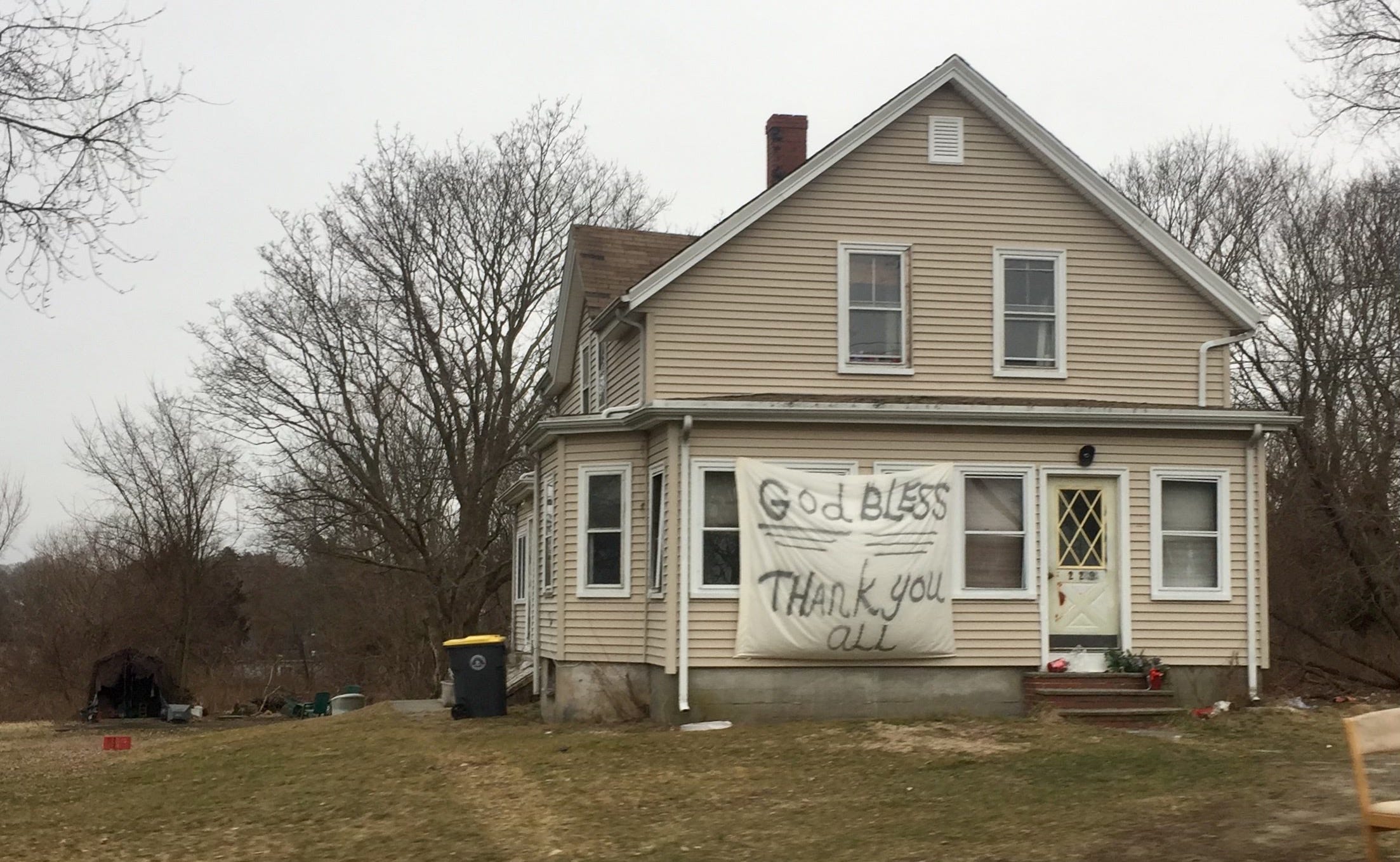
You can see it from the outside. The decomposition. Viewed from the front yard, the whole house slants and twists so violently that you wonder how it manages to stay up. Grass retreats from the foundation. Attic studs jut into the air, and insulation melts away like cotton candy in the rain. It won’t be long before some load-bearing wall gives way and takes the rest of the rotted frame with it. One beam will fail, then another, and another, and the ceiling will crash through the soft floor into a pile in the basement. The floor will heave and slide, seesaw-like, and the walls will collapse into their final resting place, and I will be there in the center of it all.
This story originally appeared in Beyond the Vanishing Point in 2024.